
While this portal is new, our core platform remains unchanged. This is purely a documentation frontend update.
RSS Feed
Changelog
Changelog is the source for the latest updates on our cloud platform. Stay informed about changes, enhancements, and new features that impact your experience. Explore our summaries to stay ahead and make the most of our platform's capabilities.
New Developer API Documentation (Beta) now available
We are pleased to announce the Beta release of our entirely redesigned public API Reference Documentation.
Built from the ground up to improve the developer experience (DX), this new portal transitions our API documentation to a modern, schema-driven architecture, making it faster and easier than ever to build automation on the UpCloud platform.
What's New
Our legacy documentation required manual updates, which could occasionally lead to drift between code and docs. This new portal solves that by generating documentation directly from our single source of truth: Our new (Beta) OpenAPI specification.
Key features of the new documentation portal include:
- Responsive Layout and Dark Mode: The portal features a lightning-fast, responsive multi-panel layout with native dark mode support.
- Intelligent Global Search: Quickly find endpoints, parameters, and structural schemas using a fast, built-in index.
- Machine-Readable Access: You can now directly download the raw OpenAPI specification file to generate your own type definitions, custom SDKs, or local Postman collections.
- cURL Snippets: Get instant access to cURL snippets to quickly test out API calls from your local CLI.
Coming Soon
- Code Snippets: Get instant access to code snippets to quickly test out our official SDKs and popular programming languages.
- Interactive API Playground: You can now test live API requests directly from your browser. The integrated playground handles authentication securely and lets you preview responses on the fly.
How to Get Started
Navigating and testing our endpoints in the new portal is straightforward:
- Head over to the new UpCloud Beta API Reference Portal.
- Read through the Get Started section to learn how to get an API token to authenticate your API calls.
- Select an endpoint (such as List Zones under Zone), copy the cURL snippet from the right-hand panel, paste it into your local terminal, replace
<token>in--header 'Authorization: Bearer <token>'with your API token and hit enter.
Important Notes
Transition Safety
- Main Source of Truth: The new OpenAPI-powered documentation portal will officially replace our legacy developer docs as the primary source of truth on September 1, 2026.
- Legacy Preservation: The existing documentation (
https://developers.upcloud.com) will be moved to a different location but remain available for historical reference.
OpenAPI® is a registered trademark of the Linux Foundation. Zudoku is an open-source framework licensed under the MIT License by Zuplo Inc.
Managed Kubernetes Service achieves CNCF AI Conformance
We are proud to announce that UpCloud’s Managed Kubernetes Service (UKS) has officially achieved CNCF Certified Kubernetes AI Conformance for Kubernetes version 1.35.
Why This Matters
This certification provides independent, community-defined validation that our v1.35 clusters natively support the essential primitives required to run complex, stateful machine learning and artificial intelligence workloads reliably at scale.
Whether your team is deploying distributed training jobs, serving LLM inference models, or building long-running agentic workflows, this conformance guarantees interoperability and performance for:
- Dynamic Resource Allocation (DRA): Fine-grained hardware control over multi-node GPU clusters.
- Advanced Batch Scheduling: Native support for all-or-nothing scheduling frameworks (like Kueue) to maximize expensive accelerator uptime.
- Intelligent Autoscaling: Seamless Horizontal Pod Autoscaling (HPA) integration mapped to custom AI/GPU hardware metrics.
There is no separate configuration or add-on required. All existing and newly deployed Kubernetes v1.35 clusters are fully compliant with this new cloud-native standard.
To learn more about the testing framework and portability baselines, visit the official CNCF AI Conformance Program.
New GPU Servers: NVIDIA L4, H100, and B200
We are expanding our GPU Server lineup with three new GPU options — NVIDIA L4, H100, and B200 — joining the existing NVIDIA L40S plans.
NVIDIA L4 is well-suited for image generation, speech-to-text, and basic inference workloads. Plans are available with 1, 2, or 3 GPUs and up to 32 CPU cores and 384 GB of RAM.
NVIDIA H100 targets high-traffic inference, large-scale batch processing, and model training. Multi-GPU configurations of 2, 4, and 8 GPUs are available, scaling up to 96 CPU cores and 1920 GB of RAM. All H100 plans include NVLink, providing 900 GB/s of bidirectional GPU-to-GPU bandwidth for efficient distributed workloads.
NVIDIA B200 is designed for the most demanding AI workloads, including trillion-parameter model inference and real-time complex model execution. Multi-GPU configurations with NVLink are available, offering 1.8 TB/s of GPU-to-GPU bandwidth.
All new plans follow the same billing model as existing GPU Servers — you are only charged when the server is powered on. See the GPU Server configurations page for the full list of available plans.
MySQL v8.4 LTS now available
We are pleased to announce the availability of MySQL v8.4 Long-Term Support (LTS) on UpCloud's Managed Databases Service.
What's New
As the first Long-Term Support release in MySQL's updated release lifecycle, MySQL 8.4 focuses on long-term stability, security patches, and critical bug fixes. It introduces refined engine defaults, performance optimizations for InnoDB workloads, and strengthened cryptographic standards. For comprehensive information about new features and structural modifications, please refer to the official MySQL 8.4 release notes.
Deployment Options
You can deploy MySQL 8.4 database instances through the following methods:
- Create a new database instance via the UpCloud Control Panel
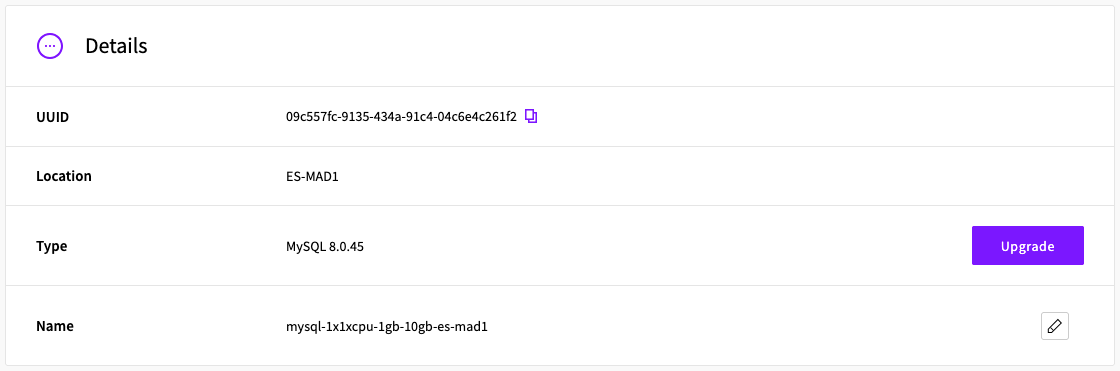
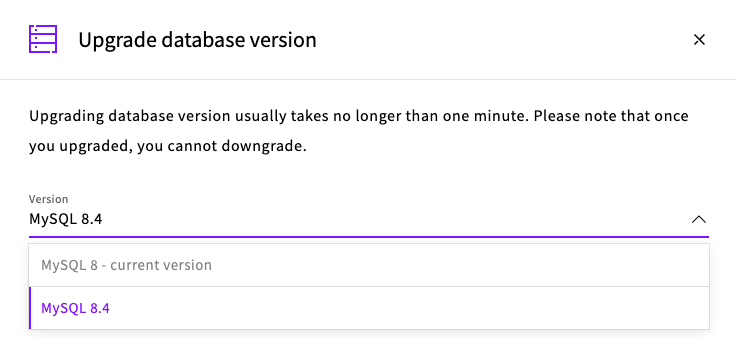
- Upgrade an existing instance to MySQL v8.4 through UpCloud Hub or through the UpCloud API.
Important Notes
Upgrades are irreversible: Major version upgrades modify data directories permanently. We highly recommend testing the upgrade path on a clone of your service before applying it to your production environments.
Authentication & Legacy Compatibility: MySQL 8.4's has moved on the
caching_sha2_passwordauthentication mechanism. However, to ensure seamless, zero-downtime upgrades for existing applications that still rely on legacy drivers, themysql_native_passwordplugin remains loaded and available by default.
MySQL is a registered trademark of Oracle and/or its affiliates.
Kubernetes v1.35 now available
We are pleased to announce availability of Kubernetes v1.35 on UpCloud's Managed Kubernetes Service (UKS), along with the renewal of our CNCF Kubernetes certification on v1.35 and, for the first time, achieving CNCF Certified Kubernetes AI Conformance on v1.35.
What's New
Similar to previous releases, the release of Kubernetes v1.35 introduces new stable, beta, and alpha features. For comprehensive information about new features and improvements, please refer to the official Kubernetes 1.35 release notes.
Deployment Options
You can deploy Kubernetes 1.35 clusters through the following methods:
- Create a new cluster via the UpCloud Control Panel
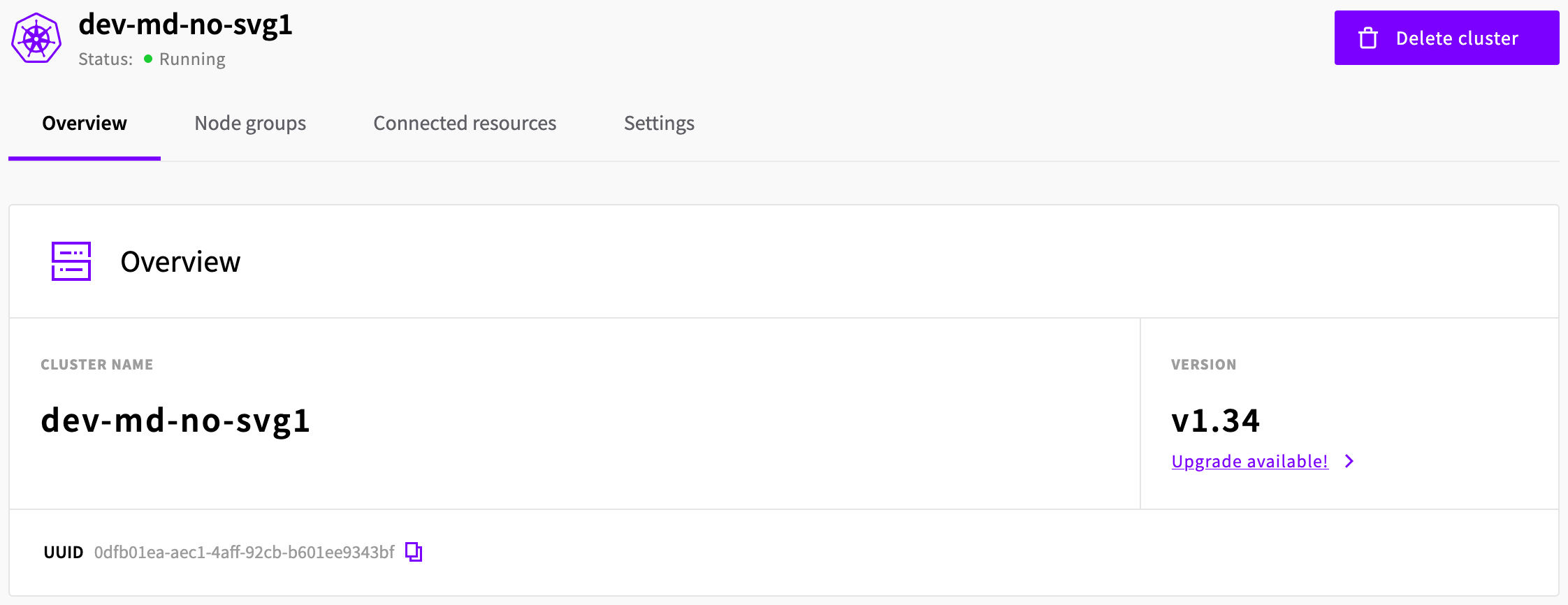
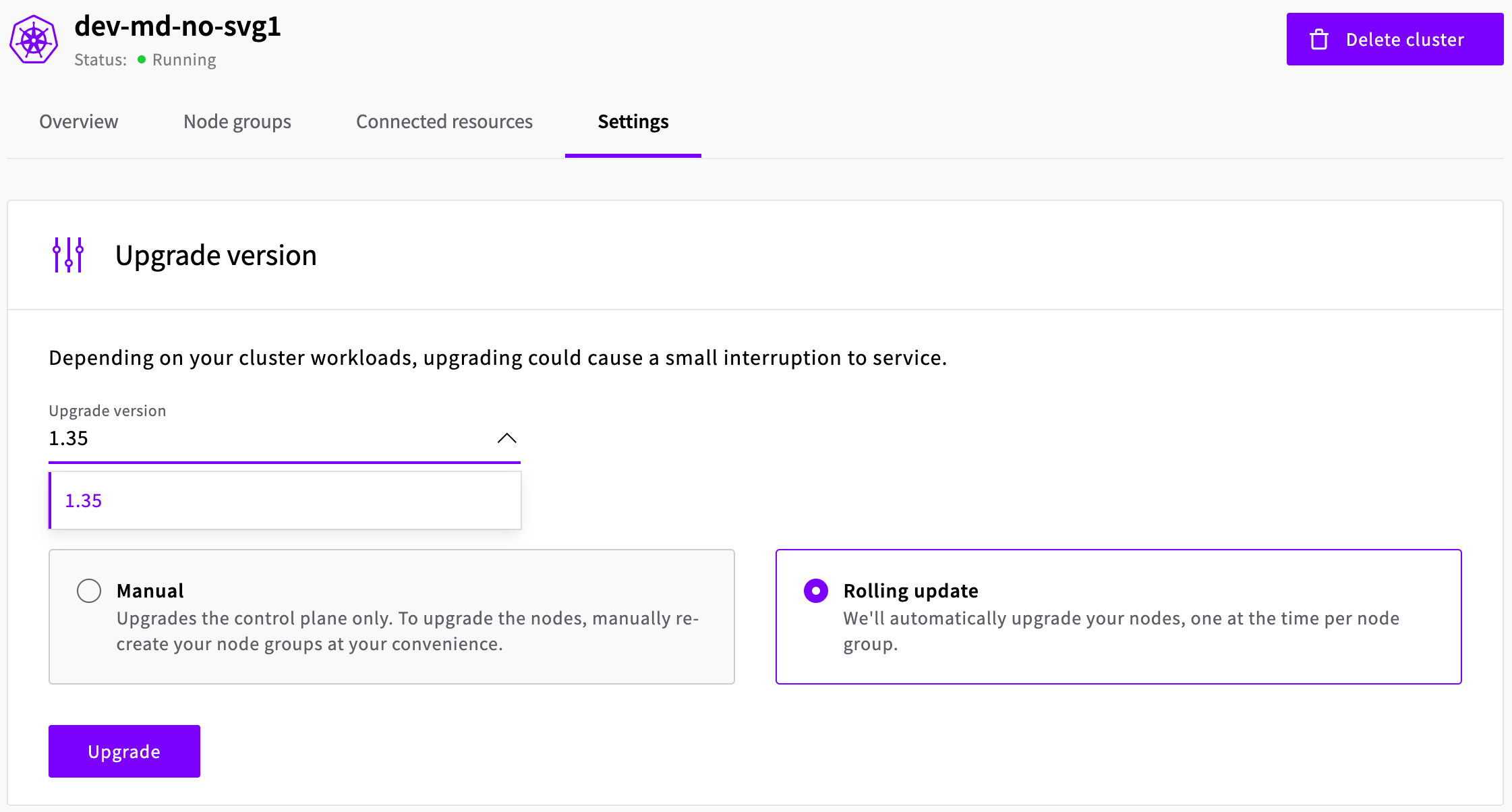
- Upgrade an existing cluster to Kubernetes v1.35 through UpCloud Hub or through the UpCloud API.
Important Notes
- The managed upgrade feature is available only for clusters running Kubernetes 1.30 or newer.
- When upgrading Kubernetes versions, you must upgrade one minor at the time. For example, when upgrading from Kubernetes v1.33 to v1.35, first upgrade to v1.34 and then to v1.35.
Kubernetes is a registered trademark of The Linux Foundation.