The evolution of cloud servers in modern computing
-
About
- Type
- Blog
- Categories
- Industry analysesLong reads
New - NVIDIA B200 & B300 Dedicated GPU Clusters | Explore GPU clusters
About
Posted on 4.7.2024
Cloud computing has drastically changed how information technology (IT) professionals utilise technology. This infrastructure has enabled businesses to use online tools, platforms, and storage spaces, thereby reducing the costs and operational requirements of having a physical setup.
Leveraging the cloud reduces costs in data storage, application execution, operations scaling, and more. Due to this and increased efficiency, cloud computing has become necessary for enterprises. In this blog, we’ll cover the history of cloud servers, future trends, challenges, and more. Let’s begin.
Cloud computing, in its infant stages, has existed since the 1960s. However, its current form didn’t prevail until the early 2000s. It originated as dedicated servers, each intended to perform a different function. A server drawback, however, was that the servers had initial high acquisition and maintenance costs.
With time, a solution to this emerged in the form of virtual private servers (VPS). This technology helped enable several virtual servers that relied on a single physical infrastructure, leading to optimised resource consumption and lower costs. Cloud-based Infrastructure as a Service (IaaS), Platform as a Service (PaaS), and Software as a Service (SaaS), as we know them today, were initially developed by tech giants like Microsoft, Google, and Amazon.
Amazon Web Services (AWS) was one of the first significant cloud service providers. Introduced in 2006, it offered scalable and on-demand processing capacity. Cloud services’ capabilities and accessibility increased rapidly following the offerings of other hyperscalers such as Microsoft and Google.
These platforms allowed companies to rent storage and processing power rather than buy pricey hardware. The evolution of cloud technology led to the general advancement of the field. In 2012, UpCloud saw an opportunity to surpass the standard cloud offerings by outperforming the existing competition with high-performance storage and computation. Cloud solutions have become a significant part of the technological landscape and continue to shape its development.
Cloud computing has had a significant impact on modern computing given that it has improved the accessibility and usability of a wide variety of applications and functions that include:
Source: Techopedia
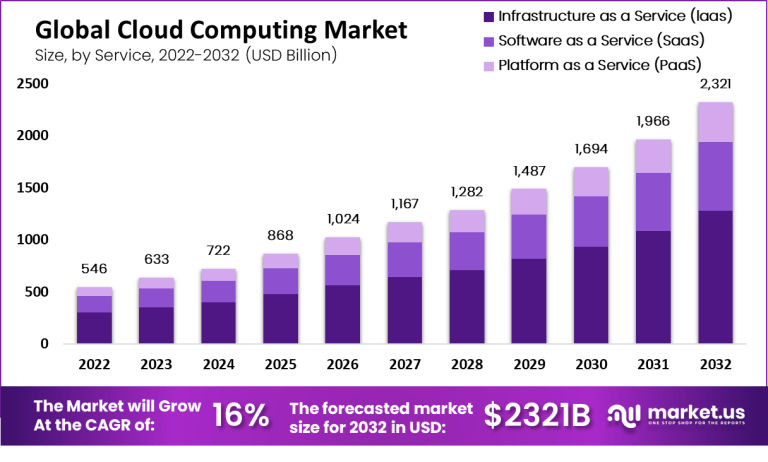
Given the impact of cloud servers on modern computing, its market is expected to grow at a 16% Capital Annual Growth Rate (CAGR) up till 2032. Some of the most notable trends for the future include:
Cloud computing has numerous benefits; however, businesses must ponder a few challenges. These include:
Cloud computing has transformed the use of technology due to its scalability and adaptability. It has advanced significantly from its early stages with dedicated servers to the sophisticated cloud infrastructure we have today.
Future developments, such as demands on privacy compliance, machine learning, and improved security, can transform the technology altogether. However, to fully realise the benefits of cloud computing, businesses must consider various factors when choosing their cloud provider.
Contact us and learn more about how we can help you leverage the cloud for your business today!