Meet Our New Public API Docs
-

-
About
- Type
- Blog
- Categories
- AnnouncementsPeopleVision and culture
About
Posted on 18 September 2026
Today, we’re making our new Public API documentation the main source of truth for the UpCloud API.
The new documentation is generated directly from our public OpenAPI specification. This brings our API, documentation and developer tooling into one connected workflow, helping us deliver new services and features with accurate documentation from day one.
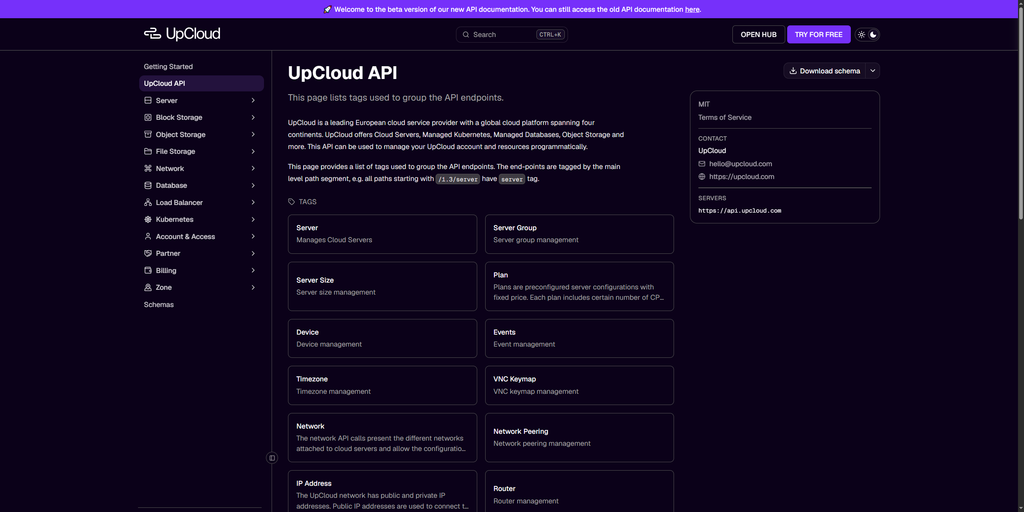
From now on, all new UpCloud services and features will be instantly documented in our OpenAPI specification and API docs, and supported across our developer ecosystem. The specification becomes the shared foundation for our API documentation and, over time, future versions of tools such as OpenTofu,Terraform, Pulumi, all our existing and future SDK’s, and all future integrations.
For developers, this means a more consistent experience and significantly faster access to complete, accurate API information. For our teams, it means less repetitive work and more time to research and explore new ways to empower developers to do more with UpCloud.
“Historically, our API documentation and developer tools were built and maintained by hand. That approach served us well enough, but it also created long lead times, gaps in documentation and feature parity in our developer tools, limited ecosystem reach and a growing maintenance burden. Scaling the ecosystem meant scaling the manual work behind it. With this approach, we’re now able to achieve instant feature-parity across our docs and all developer tools, and to introduce new ones for marginal additional effort, which enables us to empower more developers than ever before”
Miguelángel Fernández, Lead Product Manager, Platform & DevEx at UpCloud
The new API documentation includes:
We’re not stopping there. We’re working hard to add language-specific code samples and the ability to test endpoints directly from our docs..
This launch is a very important milestone in a long journey that began back in September 2025, when we started working towards fully automating the generation of all our developer tools.
UpCloud, has been around since 2012, and our portfolio of products has massively grown and evolved over the years. Throughout that time our API docs have been hand-crafted little by little, by many different engineers, trying to keep them up to date with the capabilities of our API. Having to inventory all those service endpoints, across so many different code repositories, owned by different teams, flipping the oldest of them on their head to make them API-first, comparing that against all our old docs, and making sure that the newly auto-generated docs didn’t leave anything behind has been a truly titanic task.
In April 2026, we published our new public OpenAPI specification for the first time. In June, we released the first beta of the new API documentation, generated entirely from that specification. Now, the new API documentation has become our official source of truth, and the entire corpus of our product guides has been updated to point to it.
Our DevEx team has lead the charge, and proven to be absolute champions of cross-team collaboration, rallying our colleagues to the cause, collaborating with them to instrument CI pipelines, enabling them on the new tooling, evangelising on the strategic importance of this effort, and plowing through constant back and forth to answer questions, remove blockers, resolve issues and edge cases. We could not be prouder of our team.
The outcome is pure gold. It supercharges how our teams develop and ship for the UpCloud ecosystem. When an API capability is defined in the specification, the same structured source can power documentation, validation and developer tools. This drastically shortens the path from feature release to developer adoption and helps prevent drift between what the platform can do and what the documentation describes and our developer tools support.
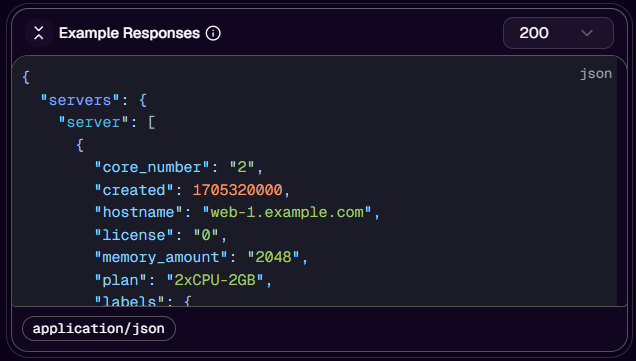
Visiting developers.upcloud.com now takes you directly to the new API documentation.
The previous documentation will remain available so existing links and bookmarks continue to work, but it will no longer be maintained. We’ve also updated all our existing guides to point to the new API reference.
If you maintain your own internal links or learning materials, we recommend updating them to use the new documentation.
Our next step is to finalise automation of the generation of all our existing developer tools. The goal is instant feature parity across the ecosystem with little to no manual maintenance.
From there, the same foundation can support an even broader range of tools, including:
The new documentation is live today. Explore the UpCloud Public API documentation, or download the OpenAPI specification and start building.