Compliance in Cloud Computing
-
About
- Type
- Blog
- Categories
- Data SovereigntyUpCloud Insights
New - NVIDIA B200 & B300 Dedicated GPU Clusters | Explore GPU clusters
About
Posted on 5.3.2025
If you’re reading this, it’s safe to assume your organization—like 94% of companies worldwide—already uses cloud-based infrastructure or is transitioning from on-premises to cloud-based infrastructure.
This role comes with new challenges in cloud compliance, namely safeguarding data privacy and security. Organizations must pay attention to cloud security and ensure robust data security safeguards are in place. Legal, financial, and reputational stakes are simply too high. Protecting the interests of your company, its customers, and the personnel who keep operations running is prudent and essential.
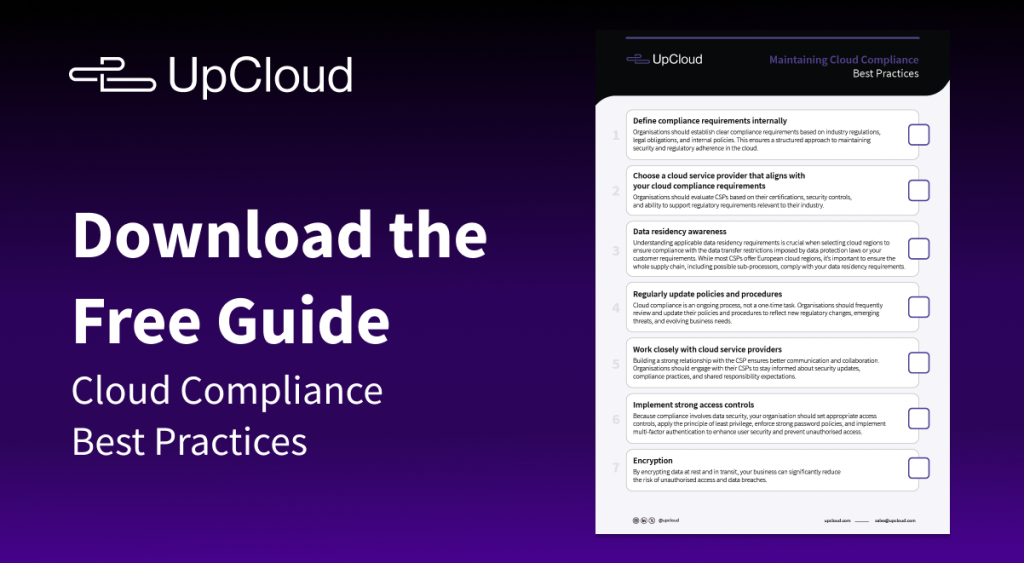
Get your free guide: Cloud Compliance Best Practices, to stay ahead!
Cybersecurity publication Cybermatters defines cloud compliance as:
“A series of practices, controls, and processes designed to align an organisation’s cloud activities with regulatory and industry standards.”
Having a cloud compliance program ensures organizations adhere to regulatory standards, national and international laws, and industry best practices in the context of cloud computing.
Compliance failures can lead to regulatory fines, lawsuits, authority investigations, and reputational damage. Organizations should understand the details of their cloud service providers’ compliance practices and how well they meet the organization’s requirements.
Compliance requirements regarding laws and regulations are not uniform across all companies. They depend on the jurisdiction in which your business operates, where your users are based, and the industry of the business. For example, the EU General Data Protection Regulation (GDPR) imposes rules on data protection and privacy for organisations that are based in the European Union or processing personal data of EU residents. An example of an industry-specific regulation is the Health Insurance Portability and Accountability Act (HIPAA), which applies to entities in the U.S. healthcare sector.
Cloud security standards are a set of requirements designed to ensure the security of data and workloads in cloud computing environments. These standards encompass a range of considerations, from the physical security of data centers to the protocols for data transmission.
Different organizations and specific use cases may require different standards. One of the most well-known frameworks for information security management systems is ISO 27001. A cloud company that holds this certification demonstrates resilience against cyberattacks and emerging threats while ensuring data integrity, confidentiality, availability, and robust security measures. Beyond ISO 27001, many other standards can further enhance your company’s cloud compliance strategy. For example, companies in the payment industry may need to consider PCI Security Standards, which support different stakeholders and functions within the industry.
Cloud compliance is a shared duty between cloud service providers (CSPs) and their customers. By sharing the responsibility, both the CSP and the customer play active roles in ensuring a secure cloud environment, reducing the risks of data breaches.
While CSPs concentrate on securing the underlying infrastructure and may offer tools to support compliance efforts, customers must oversee proper data governance, access controls, and adherence to industry regulations within their cloud environment. The division of responsibilities may vary depending on the type of cloud service in use (such as SaaS, PaaS, and Iaas) so it’s important to pay attention to your role and responsibilities with a specific cloud provider.
Cloud compliance helps your company to
Looking for a compliant cloud-hosting provider? Consider UpCloud.
Alongside our ISO 27001 certification and CISPE Code of Conduct compliance, ensuring the highest standards of data security, UpCloud’s European approach to cloud security offers unique benefits to businesses looking to operate in the EU.
To learn more about how UpCloud can support your cloud compliance needs, reach out to us today—our experts are ready to help meet your business requirements!